
CLIFF: Continual Learning for Incremental Flake Features in 2D Material Identification
Paper
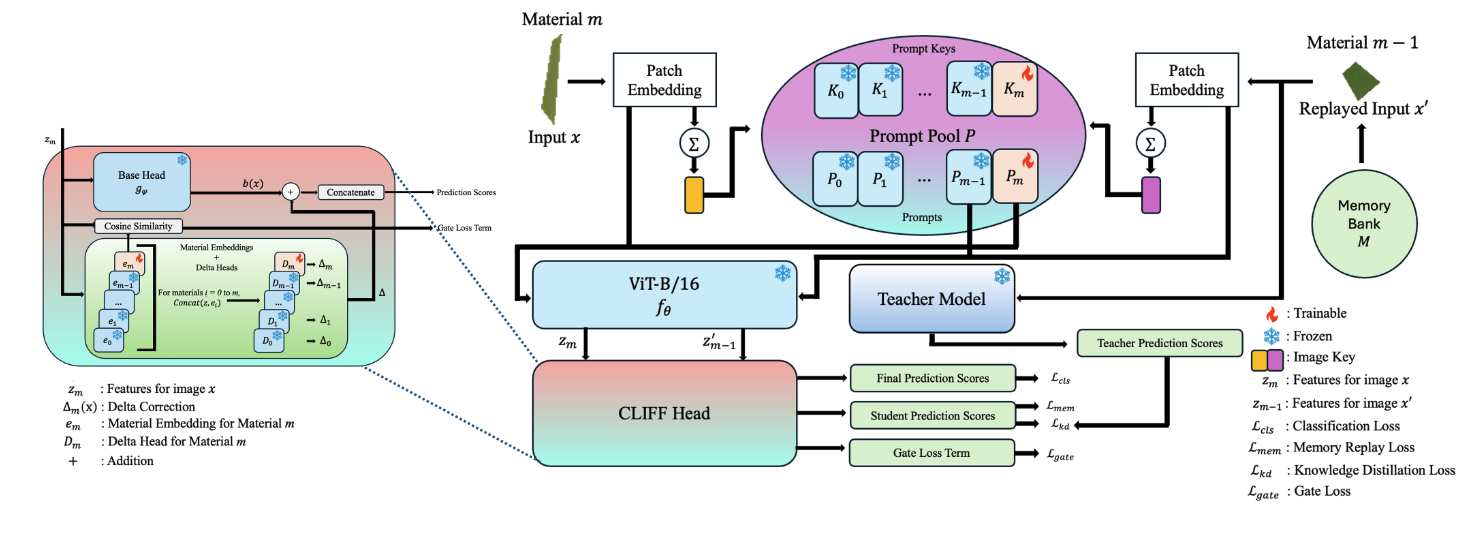
Dentifying quantum flakes is crucial for scalable quantum hardware; however, automated layer classification from optical microscopy remains challenging due to substantial appearance shifts across different materials. In this paper, we propose a new Continual-Learning Framework for Flake Layer Classification (CLIFF). To our knowledge, this is the first systematic study of continual learning in the domain of two-dimensional (2D) materials. Our method enables the model to differentiate between materials and their physical and optical properties by freezing a backbone and base head trained on a reference material. For each new material, it learns a material-specific prompt, embedding, and a delta head. A prompt pool and a cosine-similarity gate modulate features and compute material-specific corrections. Additionally, we incorporate memory replay with knowledge distillation. CLIFF achieves competitive accuracy with significantly lower forgetting than naive fine-tuning and a prompt-based baseline.
Sankalp Pandey, Xuan Bac Nguyen, Nicholas Borys, Hugh Churchill, Khoa Luu "CLIFF: Continual Learning for Incremental Flake Features in 2D Material Identification." Neurips Workshop (Under Submission), 2025.
QUADRO: A Hybrid Quantum Optimization Framework for Drone Delivery
Paper
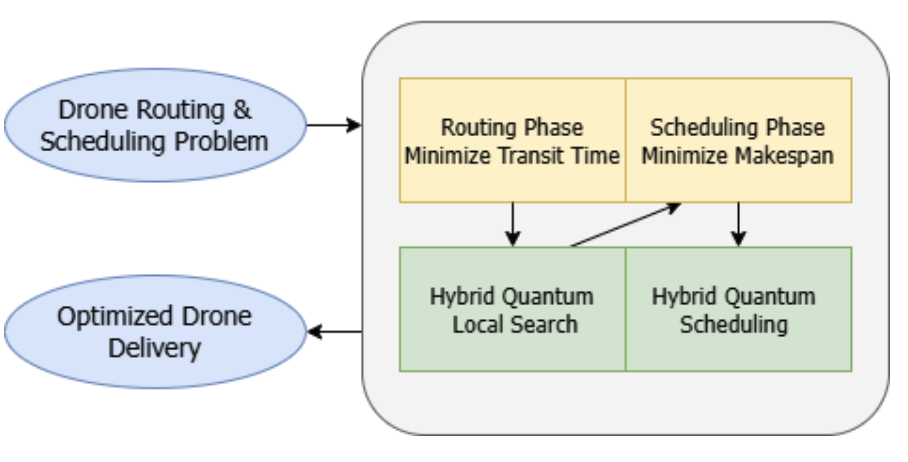
Quantum computing holds transformative potential for optimizing large-scale drone fleet operations, yet its near-term limitations necessitate hybrid approaches blending classical and quantum techniques. This work introduces Quantum Unmanned Aerial Delivery Routing Optimization (QUADRO), a novel hybrid framework addressing the Energy-Constrained Capacitated Unmanned Aerial Vehicle Routing Problem and the Unmanned Aerial Vehicle Scheduling Problem. By formulating these challenges as Quadratic Unconstrained Binary Optimization problems, QUADRO leverages the Quantum Approximate Optimization Algorithm for routing and scheduling, enhanced by classical heuristics and post-processing. We minimize total transit time in routing, considering payload and battery constraints, and optimize makespan scheduling across various drone fleets. Evaluated on adapted Augerat benchmarks (16-51 nodes), QUADRO competes against classical and prior hybrid methods, achieving scalable solutions with fewer than one hundred qubits. The proposed results underscore the viability of hybrid quantum-classical strategies for real-world drone logistics, paving the way for quantum-enhanced optimization in the Noisy Intermediate Scale Quantum era.
James B Holliday, Darren Blount, Hoang Quan Nguyen, Samee U Khan, Khoa Luu. "QUADRO: A Hybrid Quantum Optimization Framework for Drone Delivery." Quantum Week Conference 2025 .
QMoE: A Quantum Mixture of Experts Framework for Scalable Quantum Neural Networks
Paper
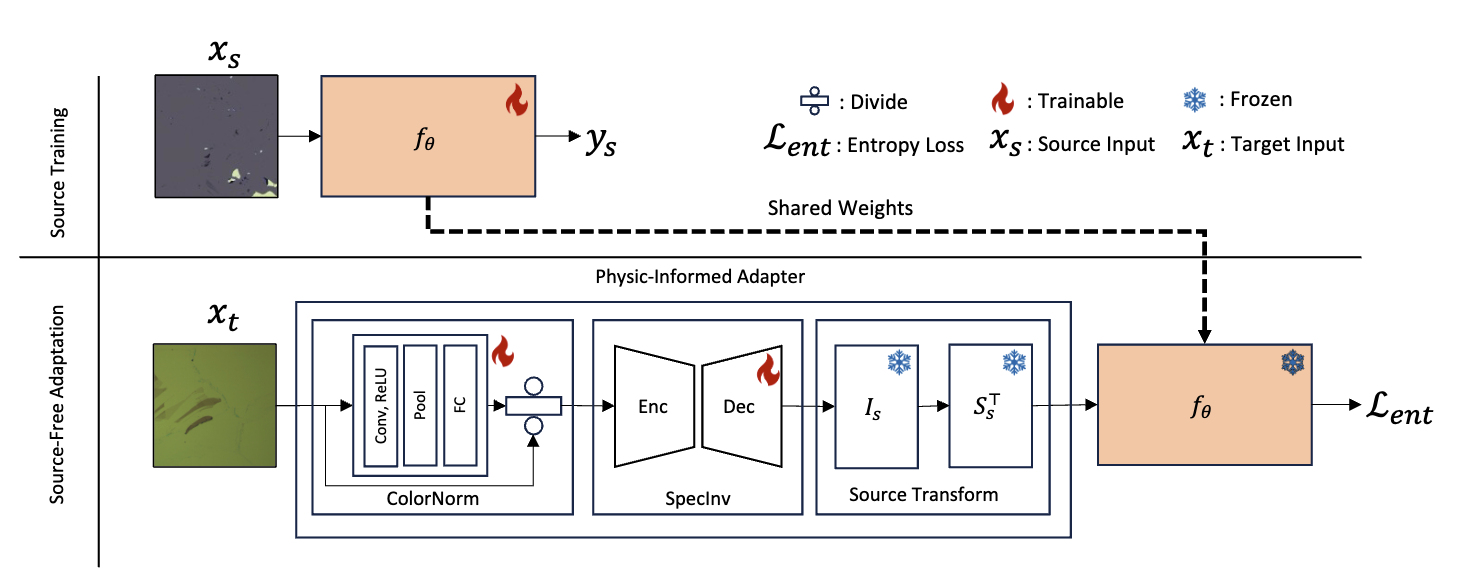
Characterizing quantum flakes is a critical step in quantum hardware engineering because the quality of these flakes directly influences qubit performance. Although computer vision methods for identifying two-dimensional quantum flakes have emerged, they still face significant challenges in estimating flake thickness. These challenges include limited data, poor generalization, sensitivity to domain shifts, and a lack of physical interpretability. In this paper, we introduce one of the first Physics-informed Adaptation Learning approaches to overcome these obstacles. We focus on two main issues, i.e., data scarcity and generalization. First, we propose a new synthetic data generation framework that produces diverse quantum flake samples across various materials and configurations, reducing the need for time-consuming manual collection. Second, we present -Adapt, a physics-informed adaptation method that bridges the performance gap between models trained on synthetic data and those deployed in real-world settings. Experimental results show that our approach achieves state-of-the-art performance on multiple benchmarks, outperforming existing methods. Our proposed approach advances the integration of physics-based modeling and domain adaptation. It also addresses a critical gap in leveraging synthesized data for real-world 2D material analysis, offering impactful tools for deep learning and materials science communities.
Hoang-Quan Nguyen, Xuan-Bac Nguyen, Sankalp Pandey, Samee U Khan, Ilya Safro, Khoa Luu. "$Phi$-Adapt: A Physics-Informed Adaptation Learning Approach to 2D Quantum Material Discovery". Quantum Week Workshop 2025.
$Phi$-Adapt: A Physics-Informed Adaptation Learning Approach to 2D Quantum Material Discovery
Paper
Parameterized Quantum Circuits (PQCs) have been acknowledged as a leading strategy to utilize near-term quantum advantages in multiple problems, including machine learning and combinatorial optimization. When applied to specific tasks, the parameters in the quantum circuits are trained to minimize the target function. Although there have been comprehensive studies to improve the performance of the PQCs on practical tasks, the errors caused by the quantum noise downgrade the performance when running on real quantum computers. In particular, when the quantum state is transformed through multiple quantum circuit layers, the effect of the quantum noise happens cumulatively and becomes closer to the maximally mixed state or complete noise. This paper studies the relationship between the quantum noise and the diffusion model. Then, we propose a novel diffusion-inspired learning approach to mitigate the quantum noise in the PQCs and reduce the error for specific tasks. Through our experiments, we illustrate the efficiency of the learning strategy and achieve state-of-the-art performance on classification tasks in the quantum noise scenarios.
Hoang-Quan Nguyen, Xuan Bac Nguyen, Sankalp Pandey, Tim Faltermeier, Nicholas Borys, Hugh Churchill, Khoa Luu. "$Phi$-Adapt: A Physics-Informed Adaptation Learning Approach to 2D Quantum Material Discovery". IEEE Transactions on Pattern Analysis and Machine Intelligence (Under Submission) 2025.
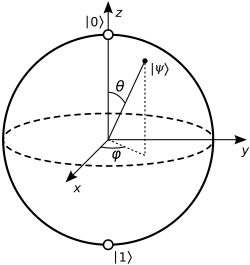
Quantum Vision Clustering
Paper
Unsupervised visual clustering has garnered significant attention in recent times, aiming to characterize distributions of unlabeled visual images through clustering based on a parameterized appearance approach. Alternatively, clustering algorithms can be viewed as assignment problems, often characterized as NP-hard, yet precisely solvable for small instances on contemporary hardware. Adiabatic quantum computing (AQC) emerges as a promising solution, poised to deliver substantial speedups for a range of NP-hard optimization problems. However, existing clustering formulations face challenges in quantum computing adoption due to scalability issues. In this study, we present the first clustering formulation tailored for resolution using Adiabatic quantum computing. An Ising model is introduced to represent the quantum mechanical system implemented on AQC. The proposed approach demonstrates high competitiveness compared to state-of-the-art optimization-based methods, even when utilizing off-the-shelf integer programming solvers. Lastly, this work showcases the solvability of the proposed clustering problem on current-generation real quantum computers for small examples and analyzes the properties of the obtained solutions
Xuan-Bac Nguyen, Hugh Churchill, Khoa Luu, Samee U. Khan. "Quantum Vision Clustering." Discover Internet of Things, Springer, 2025.
@misc{nguyen2023quantum, title={Quantum Vision Clustering}, author={Xuan Bac Nguyen and Hugh Churchill and Khoa Luu and Samee U. Khan}, year={2023}, eprint={2309.09907}, archivePrefix={arXiv}, primaryClass={quant-ph} }
Advanced Quantum Annealing Approach to Vehicle Routing Problems with Time Windows
Paper
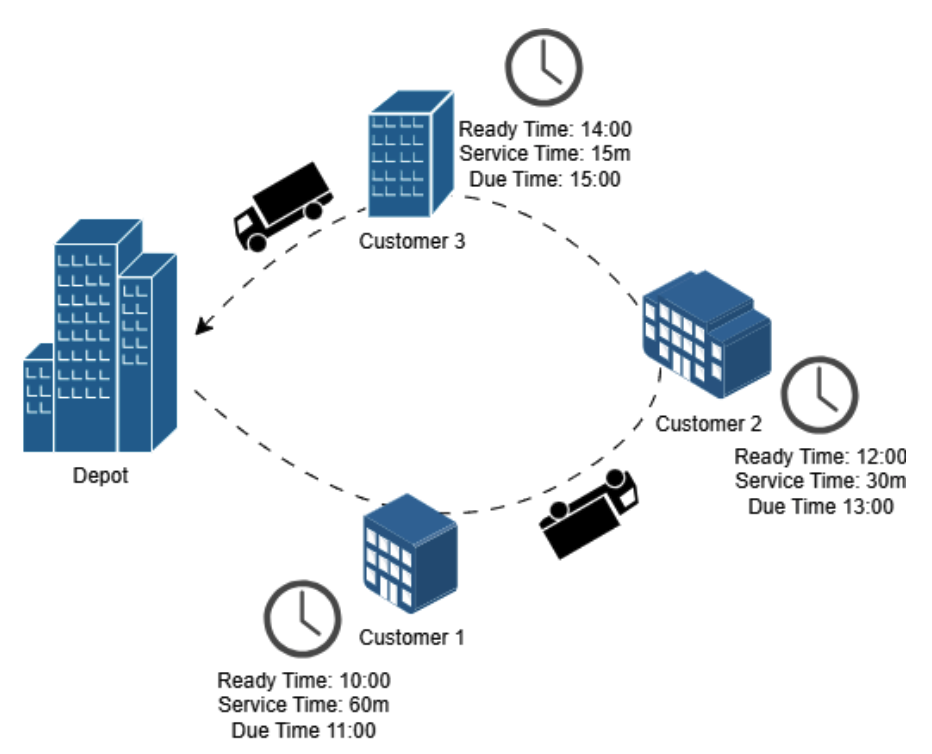
In this paper, we explore the potential for quantum annealing to solve realistic routing problems. We focus on two NP-Hard problems, including the Traveling Salesman Problem with Time Windows and the Capacitated Vehicle Routing Problem with Time Windows. We utilize D-Wave's Quantum Annealer and Constrained Quadratic Model (CQM) solver within a hybrid framework to solve these problems. We demonstrate that while the CQM solver effectively minimizes route costs, it struggles to maintain time window feasibility as the problem size increases. To address this limitation, we implement a heuristic method that fixes infeasible solutions through a series of swapping operations. Testing on benchmark instances shows our method achieves promising results with an average optimality gap of 3.86%.
James B Holliday, Darren Blount, Eneko Osaba, Khoa Luu . "Advanced Quantum Annealing Approach to Vehicle Routing Problems with Time Windows." arXiv, 2025.
An Advanced Hybrid Quantum Tabu Search Approach to Vehicle Routing Problems
Paper
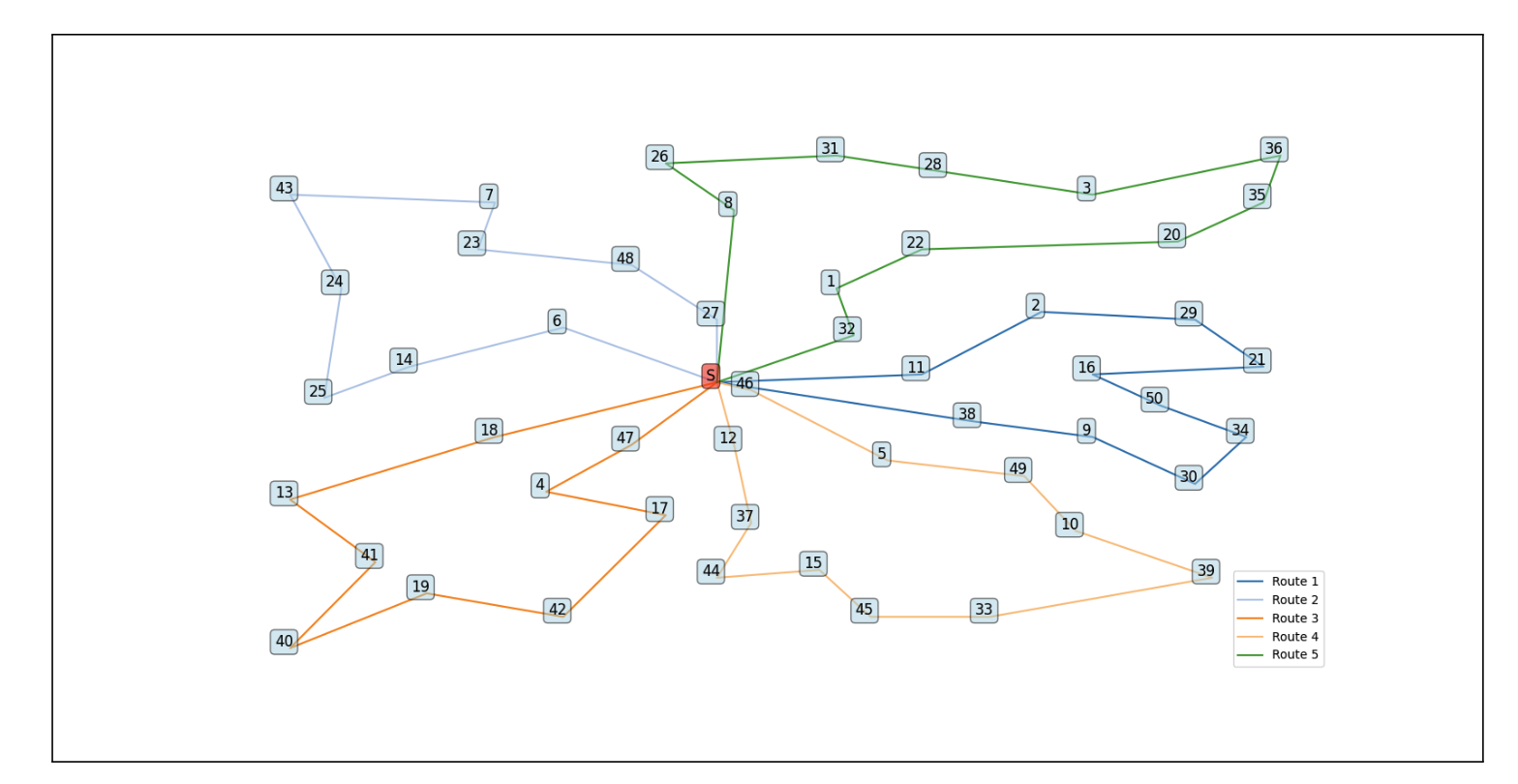
Quantum computing (QC) is expected to solve incredibly difficult problems, including finding optimal solutions to combinatorial optimization problems. However, to date, QC alone is still far to demonstrate this capability except on small-sized problems. Hybrid approaches where QC and classical computing work together have shown the most potential for solving real-world scale problems. This work aims to show that we can enhance a classical optimization algorithm with QC so that it can overcome this limitation. We present a new hybrid quantum-classical tabu search (HQTS) algorithm to solve the capacitated vehicle routing problem (CVRP). Based on our prior work, HQTS leverages QC for routing within a classical tabu search framework. The quantum component formulates the traveling salesman problem (TSP) for each route as a QUBO, solved using D-Wave's Advantage system. Experiments investigate the impact of quantum routing frequency and starting solution methods. While different starting solution methods, including quantum-based and classical heuristics methods, it shows minimal overall impact. HQTS achieved optimal or near-optimal solutions for several CVRP problems, outperforming other hybrid CVRP algorithms and significantly reducing the optimality gap compared to preliminary research. The experimental results demonstrate that more frequent quantum routing improves solution quality and runtime. The findings highlight the potential of integrating QC within meta-heuristic frameworks for complex optimization in vehicle routing problems.
James B Holliday, Eneko Osaba, Khoa Luu. "An Advanced Hybrid Quantum Tabu Search Approach to Vehicle Routing Problems." arXiv, 2025.
Diffusion-Inspired Quantum Noise Mitigation in Parameterized Quantum Circuits
Paper
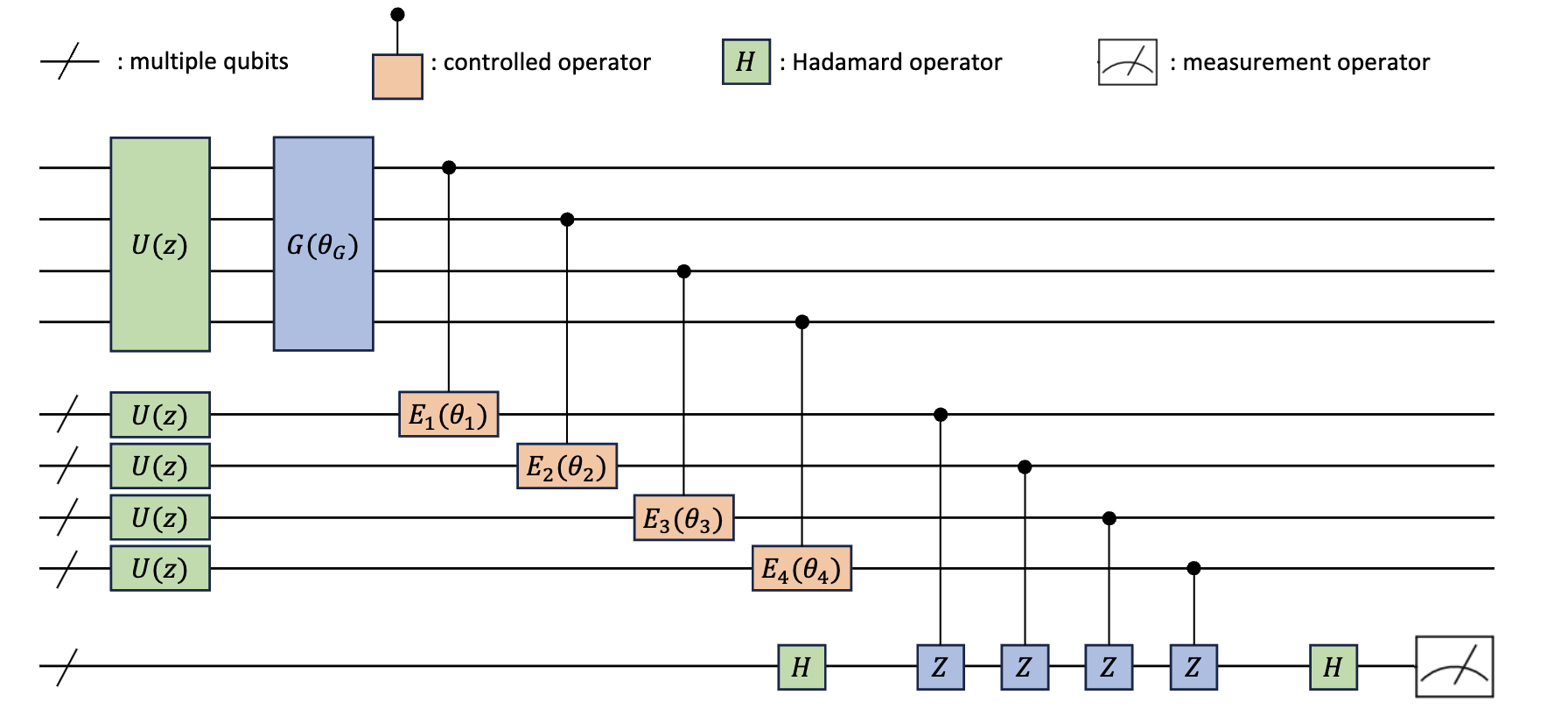
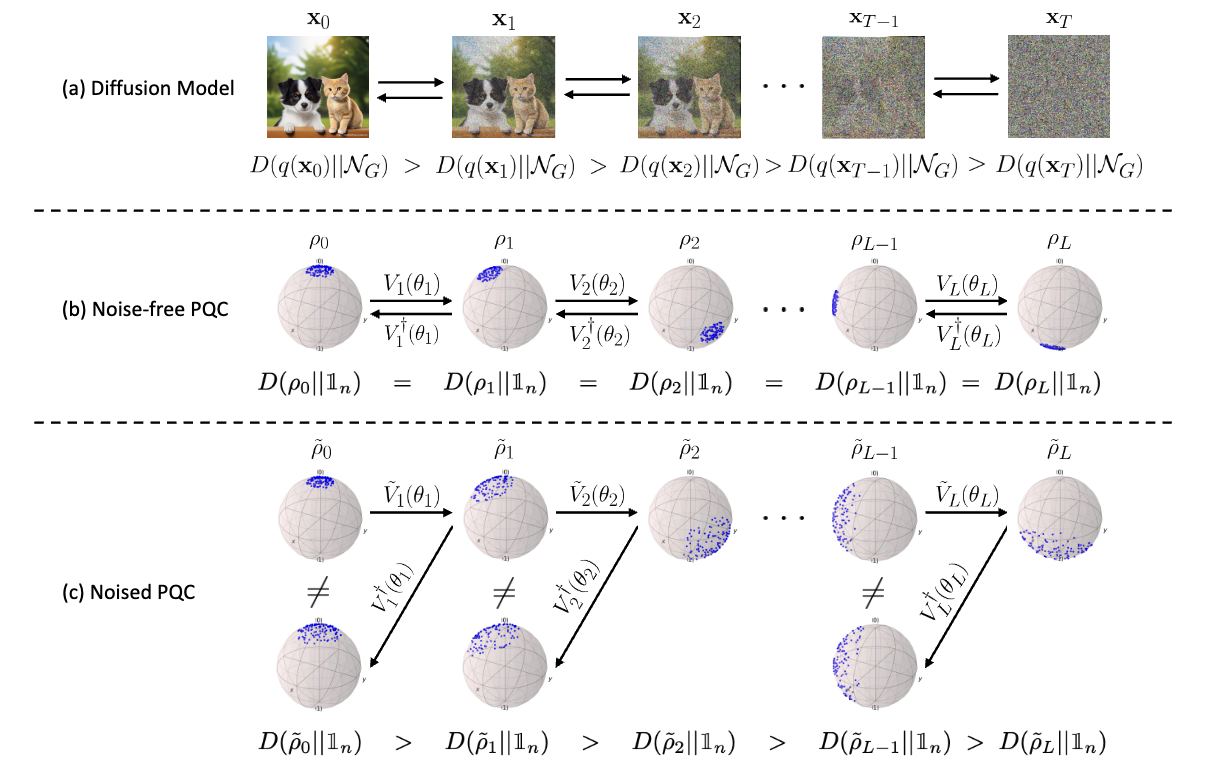
Parameterized quantum circuits (PQCs) have been acknowledged as a leading strategy to utilize near-term quantum advantages in multiple problems, including machine learning and combinatorial optimization. When applied to specific tasks, the parameters in the quantum circuits are trained to minimize the target function. Although there have been comprehensive studies to improve the performance of the PQCs on practical tasks, the errors caused by the quantum noise downgrade the performance when running on real quantum computers. In particular, when the quantum state is transformed through multiple quantum circuit layers, the effect of the quantum noise happens cumulatively and becomes closer to the maximally mixed state or complete noise. This paper studies the relationship between the quantum noise and the diffusion model. Then, we propose a novel diffusion-inspired learning approach to mitigate the quantum noise in the PQCs and reduce the error for specific tasks. Through our experiments, we illustrate the efficiency of the learning strategy and achieve state-of-the-art performance on classification tasks in the quantum noise scenarios.
Nguyen Hoang-Quan, Nguyen Xuan Bac, Samuel Yen-Chi Chen, Hugh Churchill, Nicholas Borys, Samee U. Khan, and Khoa Luu. "Diffusion-Inspired Quantum Noise Mitigation in Parameterized Quantum Circuits." Journal of Quantum Machine Intelligence, 2024.
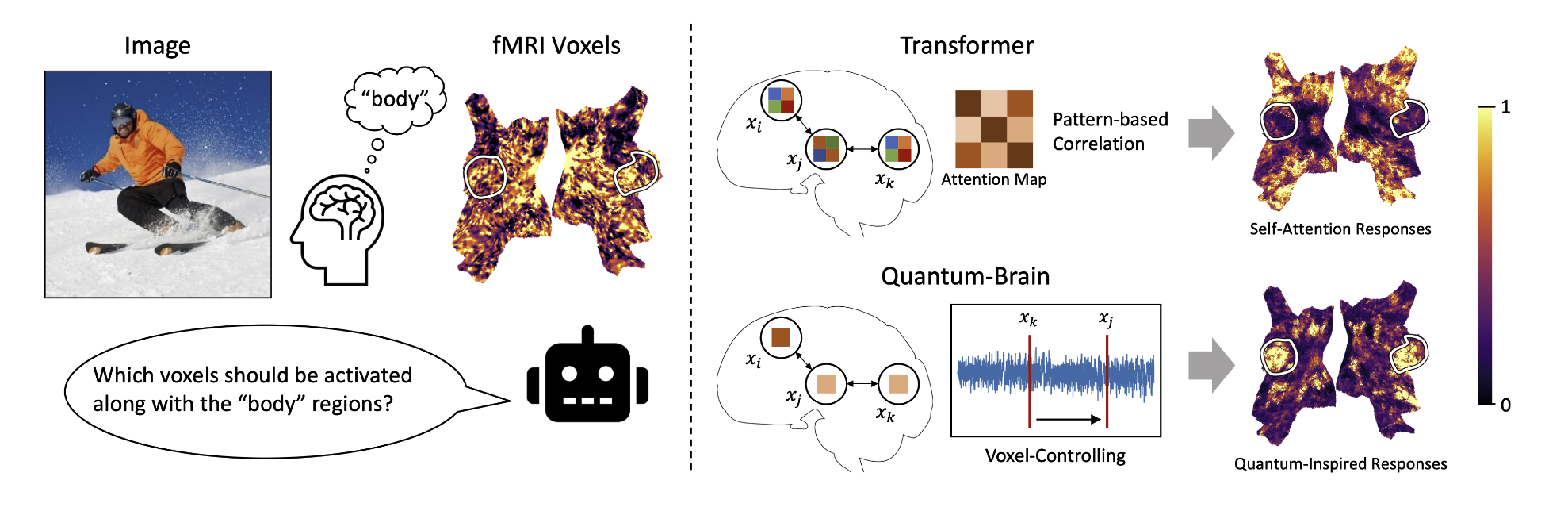
Quantum-Brain: Quantum-Inspired Neural Network Approach to Vision-Brain Understanding
Paper
Parameterized Quantum Circuits (PQCs) have been acknowledged as a leading strategy to utilize near-term quantum advantages in multiple problems, including machine learning and combinatorial optimization. When applied to specific tasks, the parameters in the quantum circuits are trained to minimize the target function. Although there have been comprehensive studies to improve the performance of the PQCs on practical tasks, the errors caused by the quantum noise downgrade the performance when running on real quantum computers. In particular, when the quantum state is transformed through multiple quantum circuit layers, the effect of the quantum noise happens cumulatively and becomes closer to the maximally mixed state or complete noise. This paper studies the relationship between the quantum noise and the diffusion model. Then, we propose a novel diffusion-inspired learning approach to mitigate the quantum noise in the PQCs and reduce the error for specific tasks. Through our experiments, we illustrate the efficiency of the learning strategy and achieve state-of-the-art performance on classification tasks in the quantum noise scenarios.
Hoang-Quan Nguyen, Xuan-Bac Nguyen, Hugh Churchill, Arabinda Kumar Choudhary, Pawan Sinha, Samee U Khan, Khoa Luu. "Quantum-Brain: Quantum-Inspired Neural Network Approach to Vision-Brain Understanding." IEEE Transactions on Pattern Analysis and Machine Intelligence (Under Submission), 2025.
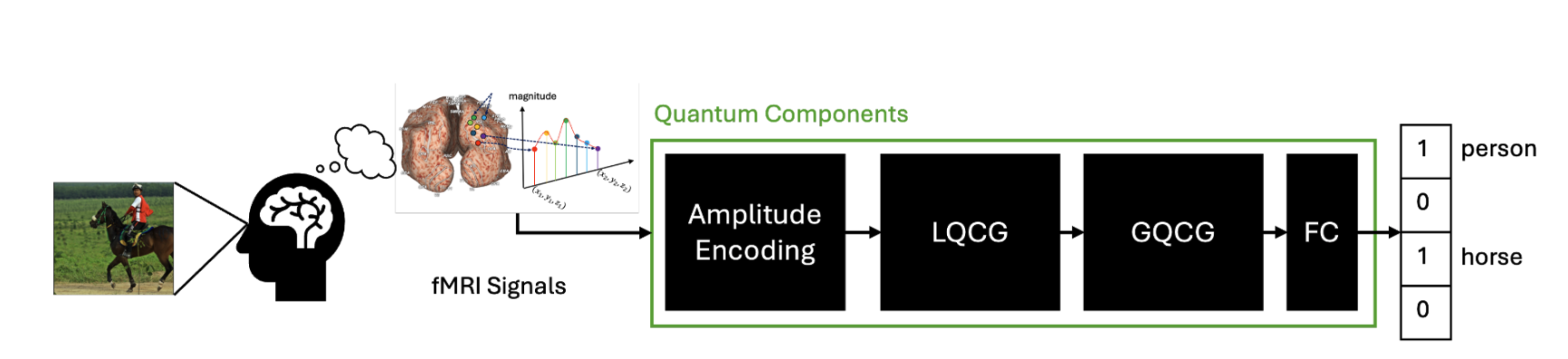
Hierarchical Quantum Control Gates for Functional MRI Understanding
Paper
Parameterized Quantum Circuits (PQCs) have been acknowledged as a leading strategy to utilize near-term quantum advantages in multiple problems, including machine learning and combinatorial optimization. When applied to specific tasks, the parameters in the quantum circuits are trained to minimize the target function. Although there have been comprehensive studies to improve the performance of the PQCs on practical tasks, the errors caused by the quantum noise downgrade the performance when running on real quantum computers. In particular, when the quantum state is transformed through multiple quantum circuit layers, the effect of the quantum noise happens cumulatively and becomes closer to the maximally mixed state or complete noise. This paper studies the relationship between the quantum noise and the diffusion model. Then, we propose a novel diffusion-inspired learning approach to mitigate the quantum noise in the PQCs and reduce the error for specific tasks. Through our experiments, we illustrate the efficiency of the learning strategy and achieve state-of-the-art performance on classification tasks in the quantum noise scenarios.
Xuan-Bac Nguyen, Hoang-Quan Nguyen, Hugh Churchill, Samee U Khan, Khoa Luu. "Hierarchical Quantum Control Gates for Functional MRI Understanding." IEEE Workshop on Signal Processing Systems, 2024.
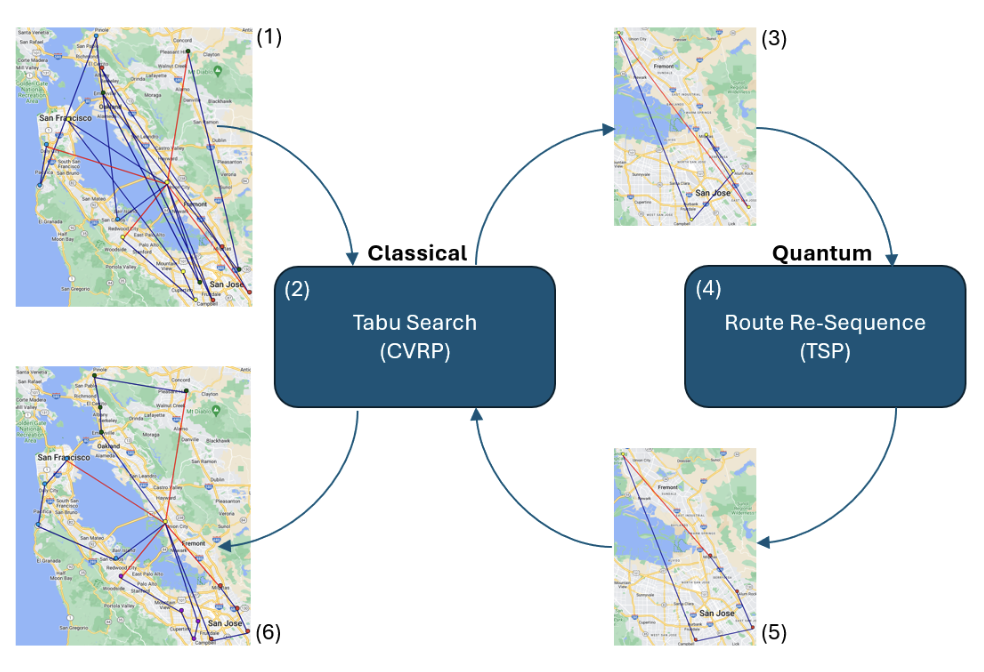
Hybrid Quantum Tabu Search for Solving the Vehicle Routing Problem
Paper
There has never been a more exciting time for the future of quantum computing than now. Real-world quantum computing usage is now the next XPRIZE. With that challenge in mind we have explored a new approach as a hybrid quantumclassical algorithm for solving NP-Hard optimization problems. We have focused on the classic problem of the Capacitated Vehicle Routing Problem (CVRP) because of its real-world industry applications. Heuristics are often employed to solve this problem because it is difficult. In addition, meta-heuristic algorithms have proven to be capable of finding reasonable solutions to optimization problems like the CVRP. Recent research has shown that quantum-only and hybrid quantum/classical approaches to solving the CVRP are possible. Where quantum approaches are usually limited to minimal optimization problems, hybrid approaches have been able to solve more significant issues. Still, the hybrid approaches often need help finding solutions as good as their classical counterparts. In our proposed approach, we created a hybrid quantum/classical meta-heuristic algorithm capable of finding the best-known solution to a classic CVRP problem. Our experimental results show that our proposed algorithm often outperforms other hybrid approaches.
James B. Holliday, Braeden Morgan, and Khoa Luu. . "Hybrid Quantum Tabu Search for Solving the Vehicle Routing Problem." IEEE Quantum Week Workshop, 2024.
@article{holiday2024hybrid, title = {Hybrid Quantum Tabu Search for Solving the Vehicle Routing Problem}, author = {James B. Holliday and Braeden Morgan and Khoa Luu}, journal = {arXiv}, year = 2024, }
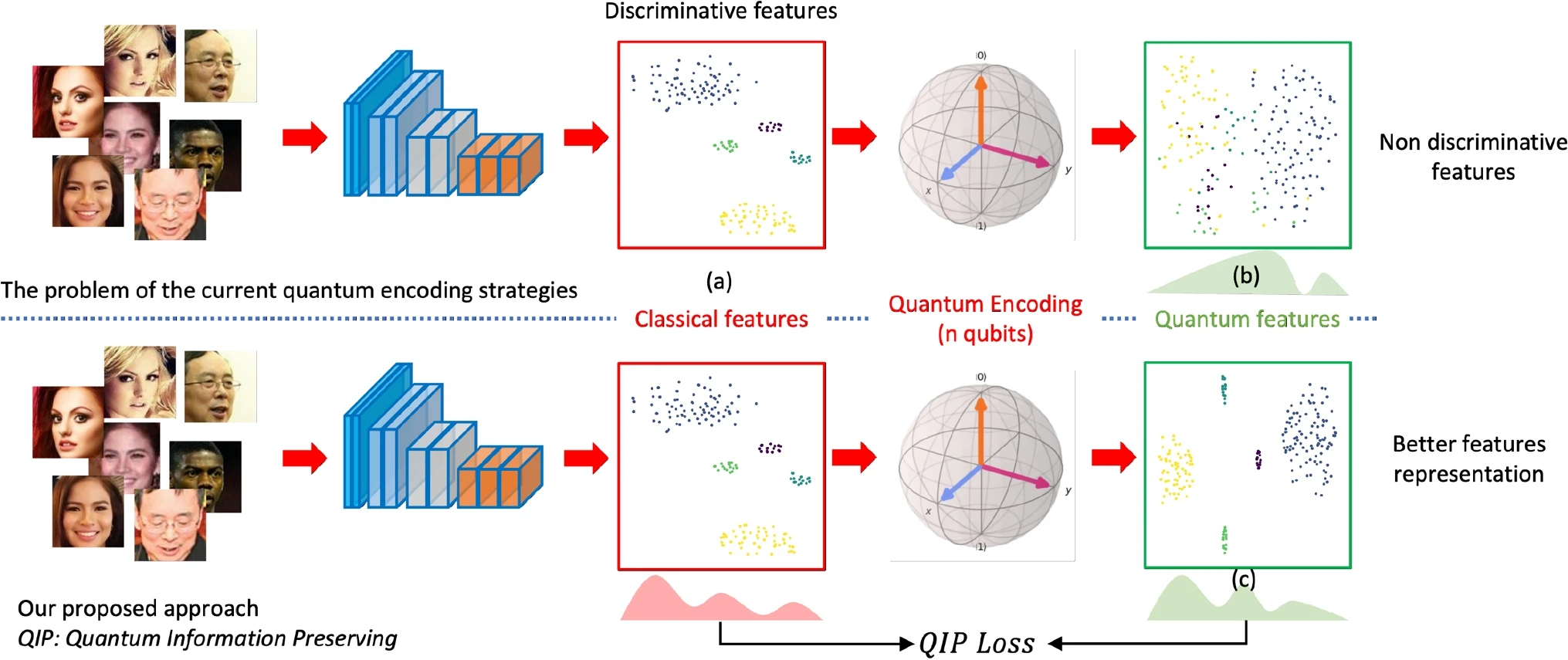
Quantum Visual Feature Encoding Revisited
Paper
Although quantum machine learning has been introduced for a while, its applications in computer vision are still limited. This paper, therefore, revisits the quantum visual encoding strategies, the initial step in quantum machine learning. Investigating the root cause, we uncover that the existing quantum encoding design fails to ensure information preservation of the visual features after the encoding process, thus complicating the learning process of the quantum machine learning models. In particular, the problem, termed "Quantum Information Gap" (QIG), leads to a gap of information between classical and corresponding quantum features. We provide theoretical proof and practical demonstrations of that found and underscore the significance of QIG, as it directly impacts the performance of quantum machine learning algorithms. To tackle this challenge, we introduce a simple but efficient new loss function named Quantum Information Preserving (QIP) to minimize this gap, resulting in enhanced performance of quantum machine learning algorithms. Extensive experiments validate the effectiveness of our approach, showcasing superior performance compared to current methodologies and consistently achieving state-of-the-art results in quantum modeling.
Xuan-Bac Nguyen, Hoang-Quan Nguyen, Hugh Churchill, Samee U. Khan, and Khoa Luu. . "Quantum Visual Feature Encoding Revisited." Journal of Quantum Machine Intelligence , 2024.
@misc{nguyen2024quantum, title={Quantum Visual Feature Encoding Revisited}, author={Xuan-Bac Nguyen and Hoang-Quan Nguyen and Hugh Churchill and Samee U. Khan and Khoa Luu}, year={2024}, eprint={2405.19725}, archivePrefix={arXiv}, primaryClass={quant-ph} }
QClusformer: A Quantum Transformer-based Framework for Unsupervised Visual Clustering
Paper
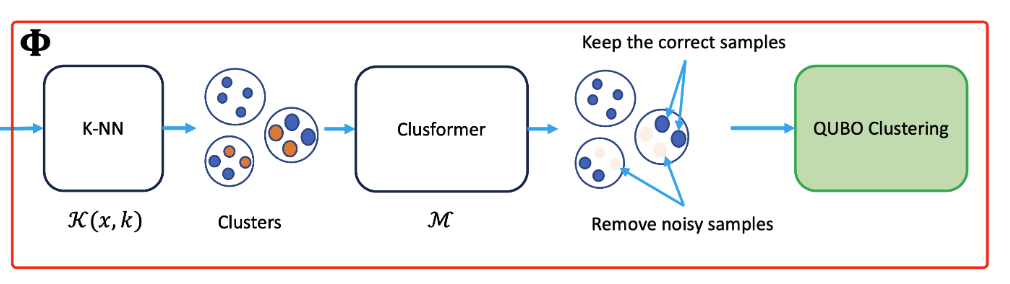
Unsupervised vision clustering, a cornerstone in computer vision, has been studied for decades, yielding significant outcomes across numerous vision tasks. However, these algorithms involve substantial computational demands when confronted with vast amounts of unlabeled data. Conversely, Quantum computing holds promise in expediting unsupervised algorithms when handling large-scale databases. In this study, we introduce QClusformer, a pioneering Transformer-based framework leveraging Quantum machines to tackle unsupervised vision clustering challenges. Specifically, we design the Transformer architecture, including the self-attention module and transformer blocks, from a Quantum perspective to enable execution on Quantum hardware. In addition, we present QClusformer, a variant based on the Transformer architecture, tailored for unsupervised vision clustering tasks. By integrating these elements into an end-to-end framework, QClusformer consistently outperforms previous methods running on classical computers. Empirical evaluations across diverse benchmarks, including MS-Celeb-1M and DeepFashion, underscore the superior performance of QClusformer compared to state-of-the-art methods.
Xuan-Bac Nguyen, Hoang-Quan Nguyen, Samuel Yen-Chi Chen, Samee U. Khan, Hugh Churchill, Khoa Luu. "QClusformer: A Quantum Transformer-based Framework for Unsupervised Visual Clustering." arXiv, 2024.
@misc{nguyen2024qclusformer, title={QClusformer: A Quantum Transformer-based Framework for Unsupervised Visual Clustering}, author={Xuan-Bac Nguyen and Hoang-Quan Nguyen and Samuel Yen-Chi Chen and Samee U. Khan and Hugh Churchill and Khoa Luu}, year={2024}, eprint={2405.19722}, archivePrefix={arXiv}, primaryClass={cs.CV} }
Two-dimensional quantum material identification via self-attention and soft-labeling in deep learning
Paper
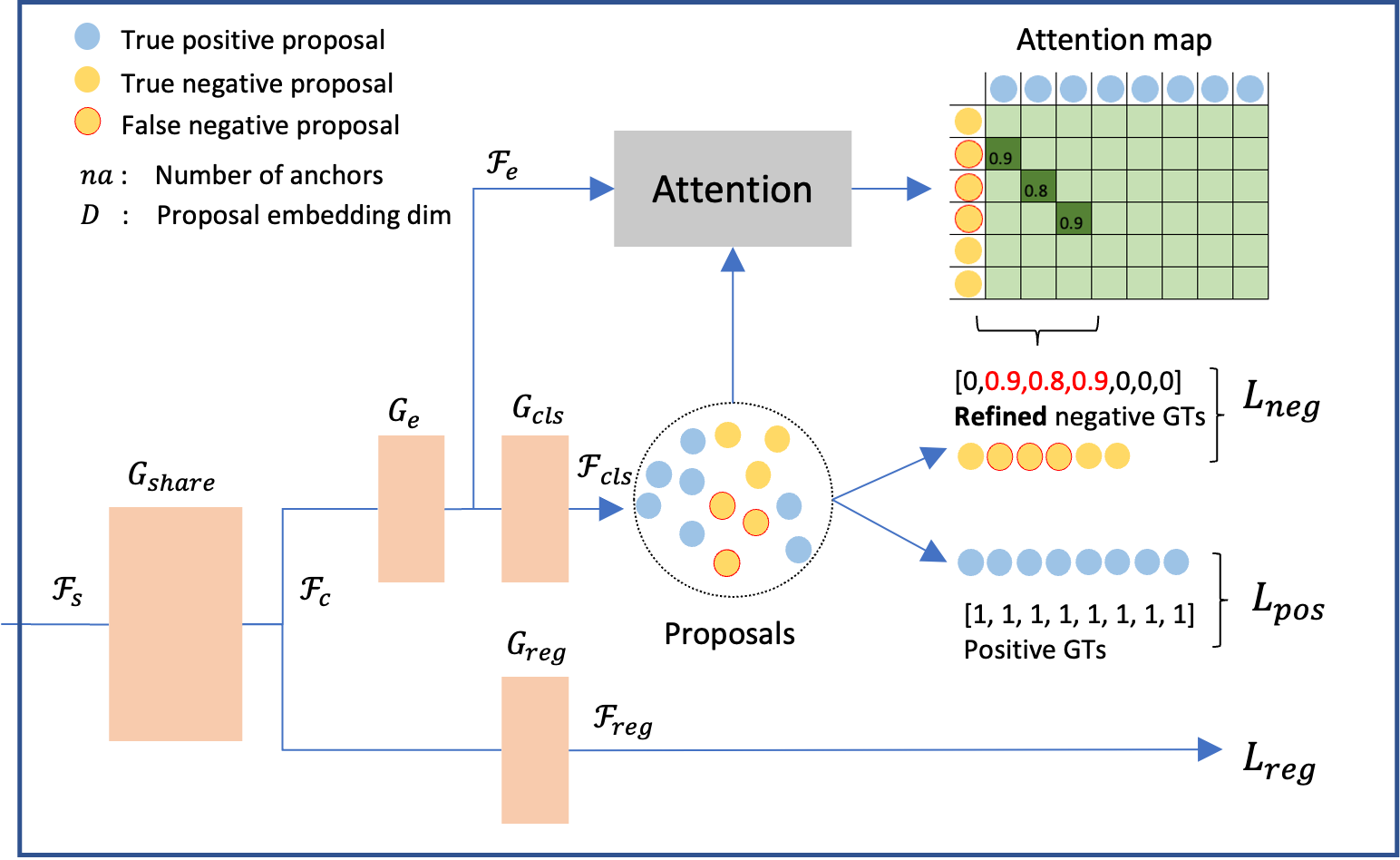
In quantum machine field, detecting two-dimensional (2D) materials in Silicon chips is one of the most critical problems. Instance segmentation can be considered as a potential approach to solve this problem. However, similar to other deep learning methods, the instance segmentation requires a large scale training dataset and high quality annotation in order to achieve a considerable performance. In practice, preparing the training dataset is a challenge since annotators have to deal with a large image, e.g 2K resolution, and extremely dense objects in this problem. In this work, we present a novel method to tackle the problem of missing annotation in instance segmentation in 2D quantum material identification. We propose a new mechanism for automatically detecting false negative objects and an attention based loss strategy to reduce the negative impact of these objects contributing to the overall loss function. We experiment on the 2D material detection datasets, and the experiments show our method outperforms previous works.
Nguyen XB, Bisht A, Churchill H, Luu K. "Two-dimensional quantum material identification via self-attention and soft-labeling in deep learning". IEEE Access, 2024.
@article{nguyen2022two, title={Two-dimensional quantum material identification via self-attention and soft-labeling in deep learning}, author={Nguyen, Xuan Bac and Bisht, Apoorva and Churchill, Hugh and Luu, Khoa}, journal={arXiv preprint arXiv:2205.15948}, year={2022} }
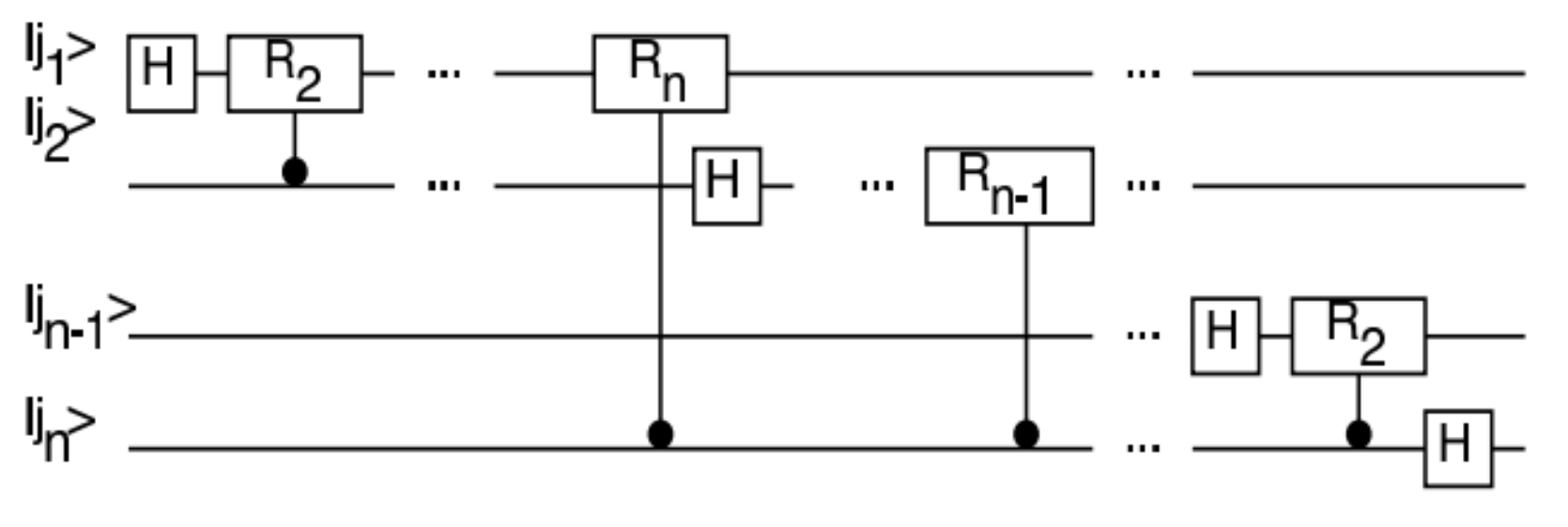
Image Processing in Quantum Computers
Paper
Quantum Image Processing (QIP)is an exciting new field showing a lot of promise as a powerful addition to the arsenal of Image Processing techniques. Representing image pixel by pixel using classical information requires an enormous amount of computational resources. Hence, exploring methods to represent images in a different paradigm of information is important. In this work, we study the representation of images in Quantum Information. The main motivation for this pursuit is the ability of storing N bits of classical information in only log(2N) quantum bits (qubits). The promising first step was the exponentially efficient implementation of the Fourier transform in quantum computers as compared to Fast Fourier Transform in classical computers. In addition, images encoded in quantum information could obey unique quantum properties like superposition or entanglement.
Dendukuri, Aditya, and Khoa Luu. "Image processing in quantum computers." In Proceedings of Quantum Techniques in Machine Learning. 2019.
@article{dendukuri2018image, title={Image processing in quantum computers}, author={Dendukuri, Aditya and Luu, Khoa}, journal={Proceedings of Quantum Techniques in Machine Learning}, year={2019} }